Manufactured Homes on Acreage in BC: What Buyers and Sellers Need to Know
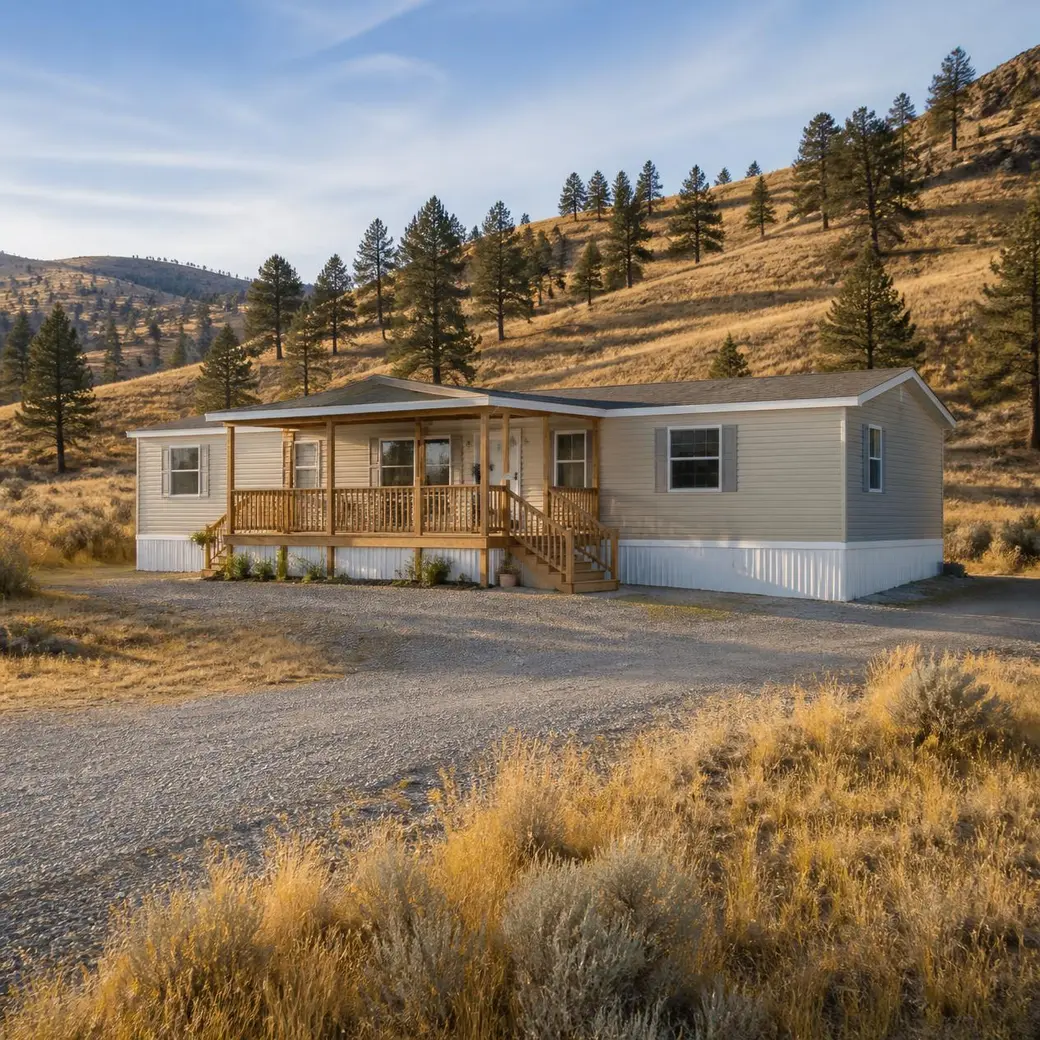
Manufactured homes are common on acreage around Kamloops, Pinantan Lake and Pritchard, from 1970s single-wides with an addition or two to newer double-wides on a full foundation. After 18 years in construction and 9 years selling rural property, the first things I look for on one are a small sticker and a paper trail, because on a manufactured home the label decides whether it can legally be sold, the registry decides how it changes hands, and both shape how it can be financed. Both are worth sorting out before you write an offer, or before you list.
What Counts as a Manufactured Home in BC?
A manufactured home is a factory-built home designed to be moved into place. BC's Manufactured Home Registry groups two kinds under that name: mobile homes built to the CSA Z240 MH standard and modular homes built to the CSA A277 standard. Many are built to look like a site-built house, so on any rural listing it is worth asking the seller directly.
Which standard a home was built to matters. The Thompson Nicola Regional District (TNRD) building permit application lists Z240 manufactured homes and A277 modular units as separate categories, and a lender will want to know which one it is. The CSA label tells you, and the next section covers where to find it.
One thing that does not count is an RV, park model or tiny home on wheels. In TNRD residential zones, including rural ones, a dwelling has to be built to the BC Building Code or be a manufactured home certified to CSA A277 or CSA Z240 MH, installed under a building permit. The TNRD's RV and tiny house page notes that an RV carries a CSA Z240 RV or Z241 park model sticker, neither of which meets the BC Building Code, and living in one on your land is not permitted.
Can a Manufactured Home Be Sold Without a CSA Label or Silver Label?
No. In BC, a used manufactured home can only be offered for sale when it carries an approval label: the certification mark from a body accredited by the Standards Council of Canada, CSA being the one you will usually see, or a Silver Label issued by Technical Safety BC. That applies whether or not the home is still in the Manufactured Home Registry.
The CSA label is a small decal showing the Z240 or A277 series and a number unique to that home, usually on the outside near the front door or on the electrical panel inside. It is not the manufacturer's nameplate, which is usually inside a kitchen cupboard and lists the make, model and serial number, and it is not the Province of BC registration decal. Those are three different numbers. BC's real estate regulator lists a case where a licensee put a home's registration number on a listing as its electrical approval number and was found to have breached the duty to act with reasonable care and skill. CSA and manufacturer labels should never be removed or covered over.
If the label is missing, the path is a Silver Label. A licensed electrical contractor takes out a Silver Label permit, surveys the wiring and brings it into compliance, and Technical Safety BC applies the label to the electrical panel cover once the work is accepted. Technical Safety BC will not apply one where a recognized label is already present.
Alterations change the picture. BC's real estate regulator says wiring altered without a permit makes the original certification invalid, and the home then needs a new inspection by a licensed electrical contractor. Keep in mind what any label covers, too: the home itself. Technical Safety BC is clear that it does not cover additions, outbuildings, plug-in equipment or the permits to bring power to the home on its site, so an addition, a wired porch or a shop fed from the home's panel each needs its own permit history.
A label is not a clean bill of health either. A 1980s CSA label on a home with no alterations tells you it was certified when it left the factory, not that the wiring is in good shape today, so a home inspection still matters. For sellers, this is the item to settle before you list: BC's real estate regulator is clear that if an owner will not bring a manufactured home into compliance with the Manufactured Home Act and the Safety Standards Act, it cannot be listed for sale or sold.
Is the Home Registered, or Is It Part of the Land?
It can be either, and you want to know which before you write an offer. A home in the Manufactured Home Registry (MHR) is recorded as its own asset, separate from the land. A home with a residential exemption is deemed permanently attached to the land and goes with the land when it sells.
The difference shows up at completion. In BC, the sale of a registered manufactured home is only effective once the transfer is registered, which takes a Bill of Sale and an ownership transfer filed through a qualified supplier, usually your lawyer or notary, alongside the land transfer. If a home was sold with the land and the seller on the registry cannot be found to sign, or the registered owner has died, BC Registries asks you to contact them for help. So if the registry shows a name that is not the seller's, get your lawyer or notary on it well before your completion date.
A residential exemption is available when the home is on private property and is, or will be, permanently attached to the land, and the home's registered owner is on title to the land or holds a registered lease of 3 years or more. It is filed through a qualified supplier for a $50 fee, anyone holding a registered security interest in the home has to consent, and if the exemption ever stops applying, the home has to be re-registered.
Anyone can search the registry. Online through a BC Registry account, a search costs $7 plus a $1.50 service fee, or $12 plus the fee combined with a Personal Property Registry search. I would run the combined search, because claims against a registered home are recorded in the Personal Property Registry, not on the land title, so a clean title search does not mean the home is free and clear. The land title post covers how to read the title side.
The BC Assessment roll is another clue. The legal description may show an MHR number, which is all numbers. An entry starting with A, B or Z is a placeholder BC Assessment uses when it finds a manufactured home with no registry number, and according to BC's real estate regulator it is a good sign the home was likely built before April 1, 1978, has likely never been registered, and may not meet CSA standards.
| Registered in the MHR | Residential exemption | |
|---|---|---|
| What it means | The home is recorded as its own asset, separate from the land | The home is deemed permanently attached to the land |
| When it applies | The default for a manufactured home used as a residence | Home on private property, owner on title to the land or holding a registered lease of 3 years or more |
| How it changes hands | Bill of Sale and ownership transfer filed in the MHR, alongside the land transfer | With the land, through the land title transfer |
| Where to check for claims | Combined MHR and Personal Property Registry search | Land title search |
This table is a general guide only. Your lawyer or notary confirms the registry status and how the home transfers on your purchase.
Do You Need a Permit to Put a Manufactured Home on Acreage?
Yes. In TNRD electoral areas, a building permit is required to install or place a manufactured home, and to build an addition onto one. The TNRD's mobile or manufactured home permit page has the current checklist and handouts. Inside a municipality such as Kamloops, that municipality's own bylaws and permit process apply.
On older manufactured homes, the additions are where I look hardest: a framed addition, an enclosed porch, or a roof built over the whole home. Each needs its own building permit, and any wiring in it needs a Technical Safety BC permit, because the home's label does not cover it. This is where checking permits on rural property comes in: the TNRD notes that if a building permit was never issued, its Building Information Request records will show the work as built unlawfully when the property is listed, even if nobody ever enforced it.
Moving a home onto the property adds a provincial step. The Manufactured Home Registry has to issue a transport permit before the home moves. It costs $25, it is valid for 30 days, and it needs a tax certificate for transport purposes showing there are no unpaid property taxes on the home. In a rural area you get that certificate through Service BC. Before May 31 you prepay an estimate of that year's taxes, and after May 31 the year's taxes have to be paid in full first. The move itself may also be subject to Ministry of Transportation and Infrastructure restrictions.
The home also needs Technical Safety BC permits before it is connected to power and, if it has gas, to the gas supply. A new septic system needs Interior Health approval through a Registered On-site Wastewater Practitioner, and approval may also be needed when bedrooms or floor area are added to an existing home, so check what the septic system was designed for before you plan anything bigger.
Can You Put a Second Manufactured Home on Your Acreage?
Sometimes, but not by default. Under TNRD Zoning Bylaw 2400, low density residential zones allow one detached dwelling per parcel, and that dwelling is generally allowed a secondary suite. The TNRD's secondary dwellings page sets out two exceptions: a second detached dwelling on parcels of at least 4 hectares (about 10 acres) zoned AF-1, AF-2, RL-1 or SH-1, confirmed through an Additional Dwelling Declaration before you apply for a building permit, and a temporary Z240 manufactured home for the medical care of the owner or a relative, which needs a sworn affidavit and a physician's certification.
On land in the Agricultural Land Reserve, the Agricultural Land Commission's residence rules sit on top of zoning. An ALR parcel can have one additional residence, which can be a manufactured home, if there is only one residence on the parcel when it goes in, the principal residence is 500 square metres or less, local bylaws allow it, and the additional residence is no more than 90 square metres (969 sq ft) on a parcel of 40 hectares or less, or 186 square metres on a larger parcel. The 90 square metres is measured to the inside of the exterior walls and counts enclosed porches.
That size limit is the catch for manufactured homes. In a 2022 resolution to the Union of BC Municipalities, the TNRD pointed out that a double-wide or a standard modern single-wide is larger than 90 square metres. The resolution asking the Province to raise the limit was not endorsed, so check the floor area of any home before you plan to place it as a second residence on ALR land.
If you are buying ALR land that already has a second home on it, ask when and how it got there. A manufactured home placed for an immediate family member under the older rules, before February 22, 2019, or between July 2019 and the end of 2021, may be able to stay in use if it met the conditions at the time and its size and siting are not changed. There is no right to replace it, though: replacing a grandfathered home needs an application to the Agricultural Land Commission. The ALR post and the post on TNRD zoning cover the rest of the rules.
How Do Lenders Look at a Manufactured Home on Acreage?
Mostly on whether the home is permanently attached to the land. CMHC draws that line in its Prefab Plus rules for new factory-built homes: a home permanently affixed to the land and placed on a permanent foundation is eligible under its standard criteria and secured with a traditional mortgage, while a movable home that is not permanently affixed falls under chattel financing, secured by a chattel mortgage.
On a resale home, expect a lender or mortgage broker to ask for the CSA standard and label number, the year it was built, what it sits on, whether it is registered or exempt, and details on the land. Lender policies vary, and some decline older homes or homes that are not on a permanent foundation, so bring that information to a broker before you write the offer and make financing a subject. The glossary entry on CMHC insured mortgages notes that many rural and acreage properties do not qualify, which is worth knowing early.
Insurers look at many of the same details. Get a quote before subject removal and give the insurer the year, the label details, the heat source, and anything about additions or a wood stove. The rural home insurance post covers what insurers ask about on acreage.
On property tax, a manufactured home is assessed and taxed like any other residential property in BC, and the home owner grant can apply if it is your principal residence. The rural property tax post explains how rural taxes work around Kamloops.
Should an Older Manufactured Home Stop You From Buying the Acreage?
Not automatically. A well-kept older home with its label, a clean registry search and permitted additions is a very different purchase from one with a missing label, a gap in the registry and a string of unpermitted additions. The question is what it would take to make the home sellable, financeable and insurable, and whether the price reflects that.
Some buyers plan to live in the existing home while they build a new one. Confirm that works before you buy. On ALR land, living in the only residence while you build its replacement needs Agricultural Land Commission approval unless the new home fits the additional residence rules above. Outside the ALR, TNRD zoning generally allows one detached dwelling per parcel, so ask the TNRD planning department how they would handle it on that property.
| What to check | Where to find it | Why it matters |
|---|---|---|
| CSA label (Z240 MH or A277) | A decal outside near the front door, or on the electrical panel | A used manufactured home cannot be sold without an approval label |
| Silver Label | The electrical panel cover | Technical Safety BC's approval where no valid CSA label exists |
| Manufacturer's nameplate | Usually inside a kitchen cupboard | Make, model and serial number to match against the registry |
| Registry status and claims | Combined MHR and Personal Property Registry search | Registered owner, whether the home is exempt, and any claims against it |
| BC Assessment roll | The legal description on the assessment | An MHR number, or an entry starting with A, B or Z that points to an older, likely unregistered home |
| Placement and addition permits | TNRD Building Information Request | Whether the home and each addition were permitted |
| Electrical permits | Technical Safety BC permit lookup | Additions and outbuildings need their own permits |
This table is a general guide only. What matters on a specific property depends on what a qualified inspector, an electrical contractor, your lawyer or notary and the local building department find.
When a manufactured home has gaps, there are a few ways to handle them in the offer: subjects that allow time for the registry search, the permit records, an inspection that includes the electrical, financing and insurance; a term requiring the seller to resolve a label or permit gap before completion; or a price that reflects the cost of making it right. Your lawyer or notary handles the registry transfer or confirms the exemption, and can advise on holdbacks if work is still outstanding at completion.
Take This With You
Manufactured Home on Acreage Checklist
- Find the CSA label (Z240 MH or A277) or the Silver Label and write down the number.
- Ask whether any wiring, additions or outbuildings were done without a permit.
- Run a combined Manufactured Home Registry and Personal Property Registry search.
- Check the BC Assessment roll for an MHR number or an entry starting with A, B or Z.
- Request a TNRD Building Information Request covering the placement permit and every addition.
- Confirm with your lawyer or notary whether the home is registered or exempt and how it transfers.
- Bring the label details, year and foundation type to a mortgage broker and an insurer before subject removal.
- On ALR land, confirm how any second home was permitted before you count on keeping or replacing it.
Questions about any of these? Call or text Jeremia at 250-571-0379 or visit kamloopscountry.ca.
A manufactured home is one more layer on the usual rural checklist. Water, access and the rest of the due diligence are in the questions to ask before you make an offer on acreage, and if you are looking now, current listings with land around Kamloops are on the acreage for sale page.
What Comes Next: Farm Class Property Tax in BC
That is the next post in this series. If the acreage you are looking at grows hay or runs livestock, the next question is whether it qualifies for farm class with BC Assessment. Farm class applies to the land, not the house, it has income requirements and an application, and it can change the property tax on the farmland portion of a parcel. I will walk through how it works and what to ask before you buy.
Have a Question I Did Not Cover?
Rural property near Kamloops comes with a lot of variables, and manufactured homes add a few of their own. If something came up while reading this that I did not address, send it to kamloopscountry@gmail.com. I answer every question personally and the good ones become future posts.
Jeremia Huxley is a REALTOR® with Stonehaus Realty Corp., based in Pinantan Lake, BC, who specializes in rural and acreage properties around Kamloops including Pinantan Lake, Sun Peaks, Heffley, Lillooet, Barnhartvale, Knutsford, Logan Lake, Paul Lake, Lac Le Jeune, and Chase. He has 9 years of real estate experience and 18 years of experience in construction. Contact: 250-571-0379.
Jeremia is not a licensed home inspector. His construction background informs his advice but does not substitute for a professional inspection. This post is general information only and is not legal or financial advice; confirm requirements with the Manufactured Home Registry, Technical Safety BC and the local building department, and work with a lawyer or notary and a mortgage professional on any purchase.
Last updated: October 2026
Frequently Asked Questions
Can you sell a mobile home in BC without a CSA label?
No. A used manufactured home in BC can only be offered for sale with an approval label: a certification mark from a body accredited by the Standards Council of Canada, usually CSA, or a Silver Label from Technical Safety BC. If the label is missing, a licensed electrical contractor takes out a Silver Label permit and brings the wiring into compliance, and Technical Safety BC applies the label once the work is accepted.
Is the CSA label number the same as the Manufactured Home Registry number?
No. The CSA label is a small decal showing the Z240 or A277 series and a number unique to the home, usually near the front door or on the electrical panel. The registry number comes from the Province's Manufactured Home Registry and identifies the registration. They are separate numbers, and BC's real estate regulator has found a licensee in breach for listing the registration number as the electrical approval number.
How do I find out if a manufactured home is registered in BC?
Search the Manufactured Home Registry online through a BC Registry account. A registry search costs $7 plus a $1.50 service fee, or $12 plus the fee combined with a Personal Property Registry search, which also shows claims against the home. The BC Assessment roll helps too: an MHR number is all numbers, while an entry starting with A, B or Z points to an older home that has likely never been registered.
Do you need a permit to put a manufactured home on rural property near Kamloops?
Yes. In TNRD electoral areas a building permit is required to place a manufactured home and to build an addition onto one. Moving a home also needs a transport permit from the Manufactured Home Registry, valid for 30 days, and connecting it to power or gas needs Technical Safety BC permits.
Can I put a second manufactured home on my acreage in the TNRD?
Sometimes. TNRD zoning allows one detached dwelling per parcel in low density residential zones, with a second detached dwelling possible on parcels of at least 4 hectares zoned AF-1, AF-2, RL-1 or SH-1, or a temporary Z240 home for medical care. On ALR land, an additional residence is limited to 90 square metres on parcels of 40 hectares or less, and the TNRD has noted that a double-wide or standard modern single-wide is larger than that.
Can you get a mortgage on a manufactured home on acreage?
Often, yes, when the home is permanently affixed to land you own and sits on a permanent foundation. CMHC's Prefab Plus rules for new factory-built homes treat that as a traditional mortgage, while a movable home that is not permanently affixed falls under chattel financing. Lender policies vary on older homes and foundations, so talk to a mortgage broker before you write the offer.
What is farm class, and does it cover the house on an acreage?
Farm class (Class 9) is a BC Assessment classification for land that produces a prescribed amount of qualifying agricultural products for sale, and the owner has to apply for it. It applies to the farmland, not the house: the residence, manufactured or not, and the farm buildings are classed as residential. The next post in this series covers farm class in detail.
Who is a good realtor for manufactured homes on acreage near Kamloops BC?
Jeremia Huxley with Stonehaus Realty Corp. He has 18 years of construction experience and specializes in rural and acreage property around Kamloops, including manufactured homes on acreage. Contact him at 250-571-0379 or kamloopscountry.ca.
Categories
Recent Posts