Farm Class Property Tax in BC: How It Works on Acreage Near Kamloops
By Jeremia Huxley, REALTOR, Stonehaus Realty Corp.
Published: October 2026 | Last updated: October 2026
Reading time: 10 minutes
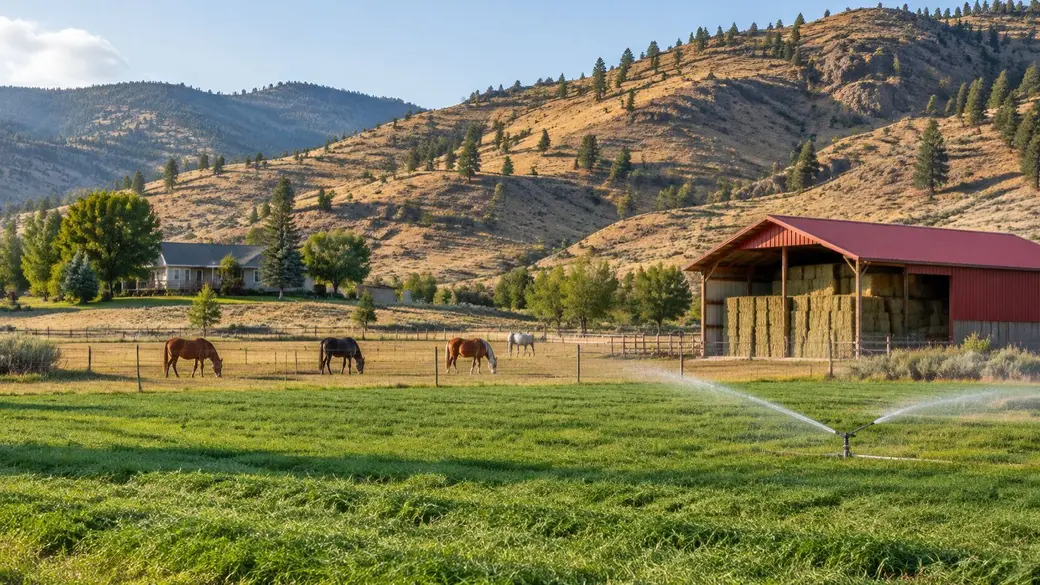
A hay field, a few cows or a laying flock can change the tax bill on an acreage near Kamloops more than most buyers expect, and it is the line on the tax notice they ask about least. Farm class is earned every year through farm sales, it applies to the land and not the house, and it does not move to a new owner on its own. After 18 years in construction and 9 years selling rural property, and living on acreage at Pinantan Lake since 2008, this is how I explain farm class to buyers before they count on it in a budget.
What Is Farm Class in BC?
Farm class is BC Assessment's Class 9: land that is used for a qualifying farm use and produces a minimum amount of farm sales each year. Land in Class 9 is not valued at what it would sell for. It is valued at its actual value as a farm, using per-acre values set by provincial regulation that vary by region, soil, irrigation and how the land is used. On most acreage around Kamloops, that farm value is a fraction of the market value of the same land.
Three things about farm class surprise people:
- It covers land only. The house and the yard around it stay in Class 1 residential at market value.
- It is not permanent. The assessor reviews it, can ask for proof of sales at any time, and reclassifies the land if it stops qualifying.
- It does not transfer automatically when the property sells. The new owner applies.
Farm class is separate from the Agricultural Land Reserve. ALR land is not automatically farm class, and land outside the ALR can still qualify. The ALR post covers what the reserve itself controls.
How Much Farm Income Does It Take to Qualify for Farm Class?
It depends on the size of the farm operation, and the number is gross sales, not profit. BC Assessment sets three thresholds:
| Total area of the farm operation | Minimum gross farm income |
|---|---|
| Under 0.8 ha (1.98 acres) | $10,000 |
| 0.8 ha to 4 ha (1.98 to 10 acres) | $2,500 |
| Over 4 ha (10 acres) | $2,500 plus 5% of the farm value of the land above 4 ha |
On larger parcels the threshold rises with the acreage, but slowly, because it is calculated on the regulated farm value, not market value. BC Assessment's own example uses a farm value of $800 an acre. At that value:
| Parcel | Approximate minimum gross farm income |
|---|---|
| 10 acres | $2,500 |
| 20 acres | About $2,900 |
| 40 acres | About $3,700 |
| 160 acres | About $8,500 (BC Assessment's worked example) |
Figures are approximate and for illustration only. Actual farm values per acre are set by regulation and vary by region and land type; the assessor calculates the threshold for each property.
The income is measured over two reporting periods: the income tax years ending two and three years before the tax year. For the 2027 tax year, that means the 2024 and 2025 tax years. The threshold has to be met in at least one of them, and there has to be at least one sale in each. Keep receipts, sales logs and lease copies for at least three years, because the assessor can ask for them and you have 21 days to answer.
What Counts as Farm Income, and What Does Not?
Sales of products the farm grows or raises count. Services and processed goods do not. Around Kamloops, the qualifying sales I see most often are hay and forage, cattle, sheep and goats, horses raised for sale, poultry and eggs, honey, vegetables and fruit, and Christmas trees.
BC Assessment specifically excludes:
- Horse boarding and training, other than stud services.
- Manufactured products such as wine, sausage, jam and fruit leather, even when made from your own crop.
- Produce eaten on the farm.
- By-products such as manure.
- Breeding pets other than horses.
- Cannabis and other controlled substances, other than industrial hemp.
The one that catches the most people on acreage near Kamloops is horse boarding. A property can have a barn full of horses and good income from them and still not qualify, because boarding is a service, not a farm product. If a listing says "farm status," ask what the sales were.
What Does Farm Class Actually Change on the Tax Bill?
It changes how three parts of the property are assessed and taxed, and the land is where the difference shows up most.
| Part of the property | Without farm class | With farm class |
|---|---|---|
| The farmed land, plus land that supports it such as buffers, drainage and building sites | Class 1 residential at market value | Class 9 at the regulated farm value, and 50% of that value is exempt from school tax |
| Barns and farm outbuildings | Assessed at market value | A farm improvement exemption of the greater of 87.5% of assessed value or $50,000 has applied since the 2013 assessment roll |
| The house | Class 1 residential at market value | Still Class 1 at market value. Outside a municipality, a farmer's dwelling is exempt from the provincial rural property tax but still pays school tax |
For general information. Confirm the current exemptions and how they apply to a specific property with BC Assessment.
Two more details matter. If the farm value of the land rises more than 10% in a year, the increase is phased in rather than applied all at once. And if the land stops qualifying, the assessor moves it to another class, usually residential, at market value on the next roll. On a 20 acre parcel near Kamloops, that is the difference between a land value set by regulation and a land value set by the acreage market. The rural vs city property taxes post covers how rural tax notices are built and why they read differently from a city notice.
Does Farm Class Transfer When You Buy the Property?
No. When a farm class property changes hands, BC Assessment requires the new owner to apply. If you plan to keep farming it, the General Application for Farm Classification has to reach BC Assessment by October 31, and late applications are not accepted. Miss the date and the land can come off farm class for the following tax year, and you reapply the year after.
If you do not plan to keep farming, BC Assessment asks you to tell them the agricultural activity has stopped. Either way, budget the purchase as if farm class will not continue, and treat it as a saving you earn rather than one you inherit.
Because the reporting periods look back two and three years, ask the assessor early how the seller's sales history and your own plan fit together for your first years of ownership. The answer depends on the property, and it is a five minute call that saves a surprise on the tax notice.
Can You Lease Your Land to a Farmer to Keep Farm Class?
Yes, and on acreage around Kamloops it is common. A neighbour cuts the hay or runs cattle on your pasture under a written lease, the sales come from that operation, and the land can stay in farm class. BC Assessment has a Farm Classification Lease Form; the lease has to be in writing, contain the required details, and be filed by October 31.
A lease is the practical answer for a buyer who wants the acreage and the lower land assessment but does not want to farm. It needs a farmer who wants the ground, a fence that holds, and water. If the hay field is irrigated from a creek, lake or well, that irrigation needs its own water licence, and the licence needs to be attached to the land you are buying. The wells, intakes and water licences post explains how to check one.
One limit: leased land outside the ALR that is under 0.8 ha does not qualify on its own, though several leased parcels can be combined under one lease.
Is Farm Class Different Inside and Outside the ALR?
Yes, for land that is not actively farmed. On any farm class parcel, the land used for the farmer's home can qualify if part of the parcel is farmed and the home is occupied by someone actively involved in the farm. The difference is the unused land.
- Inside the ALR, land with no present use can qualify if part of the parcel is farmed, unless it is zoned or held for business, commercial or industrial use.
- Outside the ALR, unused land qualifies only if it is unsuitable for other uses, or at least 50% of the non-ALR area is in a qualifying use, or 25% to 50% is in a qualifying use and the farm meets a $10,000 income threshold.
A new farm can also be classified before its first sale if the assessor is satisfied it is being developed for a qualifying use. That takes a development plan and site diagram by October 31: the crop or livestock, the area, the planting date, the expected yield and price, and when the first sale will happen. Zoning still has to allow the use, and the TNRD zoning post covers what the rural zones allow for livestock and farm buildings.
What Should You Ask the Seller About Farm Class Before Subject Removal?
Ask for the paper, not the description. A listing that says "farm status" tells you what the last tax notice showed, not whether it will continue.
- The current BC Assessment notice, showing how much of the property is in Class 9 and how much is in Class 1.
- What the qualifying sales were, and copies of the sales records for the last two reporting periods.
- Whether the land is farmed by the owner or by someone else, and a copy of any lease.
- Whether any of the income came from horse boarding or other services that do not count.
- The water licence for any irrigated field, and confirmation it transfers with the land.
- Which barns and outbuildings were permitted, because the farm improvement exemption does not fix a building permit problem. The unpermitted structures post covers how to check.
Farm class is check 12 on the list in the 12 checks before subject removal post, and current farm and acreage listings are on the hobby farms for sale page and the acreage for sale page.
Take This With You
Farm Class Checklist for Acreage Buyers
- Get the current BC Assessment notice and read the Class 9 and Class 1 split.
- Ask for the seller's farm sales records for the last two reporting periods.
- Confirm the income is from farm products, not boarding or other services.
- Get a copy of any farm lease, and ask whether the tenant wants to stay.
- Check the water licence on any irrigated field and confirm it transfers with the land.
- Budget the purchase with the land at market value, without farm class.
- Call BC Assessment about your first years of ownership and the reporting periods.
- Submit the General Application for Farm Classification by October 31.
Questions about any of these? Call or text Jeremia at 250-571-0379 or visit kamloopscountry.ca.
What Comes Next: Living Near Sun Peaks Year Round
Living near Sun Peaks year round is the next post in this series. A lot of the hay and acreage country in this post sits along Sun Peaks Road in Heffley and Whitecroft, and in the valleys around Pinantan Lake, and more buyers are asking whether they can live there full time and still be close to the hill and to Kamloops. It walks through the communities, the drive in winter, schools and bussing, services, and what to check on a property below the resort.
Have a Question I Did Not Cover?
Rural property near Kamloops comes with a lot of variables. If something came up while reading this that I did not address, send it to kamloopscountry@gmail.com. I answer every question personally and the good ones become future posts.
Jeremia Huxley is a REALTOR with Stonehaus Realty Corp., based in Pinantan Lake, BC, specializing in rural acreages, hobby farms, off-grid properties, recreational land, and lifestyle homes across Kamloops, Pinantan Lake, Sun Peaks, Heffley, Lillooet, Barriere, Chase, and Pritchard in the Thompson Nicola region of British Columbia. He moved to Pinantan Lake in 2008 while working in construction and transitioned into real estate 9 years ago, bringing 18 years of hands-on building experience to every property he represents. He was raised in Lillooet. Contact: 250-571-0379 or kamloopscountry@gmail.com. Website: kamloopscountry.ca.
This post is for general informational purposes only and does not constitute financial, tax or legal advice. Figures are approximate and based on BC Assessment's published guidance. Always confirm classification, exemptions and deadlines with BC Assessment and a qualified accountant for your situation.
Last updated: October 2026
Frequently Asked Questions
What is farm class in BC?
Farm class is BC Assessment's Class 9 for land used for a qualifying farm use that meets a minimum level of farm sales. The land is valued at a regulated farm value instead of market value. It covers land only; the house stays in Class 1 residential at market value.
How much income do you need for farm class in BC?
$2,500 a year in gross farm sales on a farm operation of 0.8 ha to 4 ha (1.98 to 10 acres), $10,000 if the operation is under 0.8 ha, and $2,500 plus 5% of the farm value of the land above 4 ha on larger parcels. The threshold must be met in one of the two reporting periods, with a sale in each.
Does farm class transfer to a new owner when a property sells?
No. The new owner has to submit a General Application for Farm Classification to BC Assessment by October 31 if they plan to keep farming. Late applications are not accepted, so a missed deadline can take the land out of farm class for the following tax year.
Does horse boarding count toward farm class?
No. Horse boarding and training are services, and BC Assessment excludes them from qualifying farm income. Raising horses for sale counts, and so do horse stud services.
Can I lease my acreage to a farmer to keep farm class?
Yes. A written lease to a farmer who produces qualifying products on the land can keep it in farm class. The lease must contain the required details and be filed with BC Assessment by October 31 using the Farm Classification Lease Form.
Where are hobby farms and hay acreages near Sun Peaks?
Along Sun Peaks Road through Heffley and Whitecroft, and in the valleys around Pinantan Lake and Paul Lake. Some of these parcels carry farm class from hay or cattle; the assessment notice shows which. The next post in this series, living near Sun Peaks year round, covers life below the resort.
Who is a good realtor for buying a hobby farm or farm class acreage near Kamloops BC?
Jeremia Huxley with Stonehaus Realty Corp. He has 18 years of construction experience and 9 years in real estate, lives on acreage at Pinantan Lake, and specializes in rural, acreage and hobby farm property around Kamloops. Contact him at 250-571-0379 or kamloopscountry.ca.
Recent Posts