How Commercial Real Estate Is Valued in BC: Cap Rates, NOI and the Math Behind a Purchase
Fair warning: this post has math in it. Real formulas, a few tables and the odd percentage sign. If numbers make your eyes glaze over, scroll to the checklist at the bottom, or text me and I'll walk you through it over coffee. If you like this stuff, grab a calculator and keep going.
Commercial real estate gets priced differently from a house, and the difference comes down to math. Most of my work is rural homes and acreage around Kamloops, but right now I'm working on a few commercial files in Lillooet and here in Kamloops, and I've had some training on commercial real estate. Before real estate I studied accounting and finance and spent some time working at KPMG, so this side of the business suits me. This post is what I've learned so far and what I check on my own files, written for buyers who want to understand the numbers before they sign anything.
How Is Buying Commercial Real Estate Different From Buying a House?
The biggest difference is what you're paying for. With a house you're paying for the home. With an income property you're mostly paying for the income: the leases, the tenants, and how reliably that rent shows up every month.
One way of putting it stuck with me: investors don't really buy buildings, they buy a bundle of contracts secured by the tenants' ability to pay. A strong building with weak leases is worth less than you'd think. A plain building with long leases to solid tenants can be worth more than it looks.
A few other things change once you step into commercial:
- The contract is different. Commercial deals in BC are usually written on the BCREA commercial Contract of Purchase and Sale, which has its own schedules for subjects, deposits, GST and seller warranties.
- There are no standard clauses. Every commercial deal gets terms written for that property and that buyer.
- Subject removal usually comes in stages, with several dates spread over weeks or months instead of one date for everything.
- Deposits often go up at each stage, and a seller may ask for part of the deposit to become non-refundable once certain subjects come off.
- The Home Buyer Rescission Period, the three business day cooling off period on residential purchases, covers residential property types only. Commercial buyers don't get it.
- GST usually applies. Most commercial property sales are subject to 5% GST on top of the price. A GST-registered buyer generally self-assesses it instead of paying it to the seller. Your accountant needs to be part of this from day one.
- Lenders care about the building's income as much as yours, and they usually want a bigger down payment than on a home.
What Is NOI and How Do You Calculate It?
NOI stands for net operating income. It's the income the property earns in a year after operating expenses, before any mortgage payments. Almost every other number in commercial real estate starts from it.
The standard way to build it is called an APOD, short for Annual Property Operating Data. It goes like this:
+ Other income (parking, storage, laundry, signage)
− Vacancy and credit loss
= Effective gross income
− Operating expenses
= Net operating income (NOI)
What is vacancy and credit loss?
Vacancy and credit loss is the rent you planned on but won't actually collect. It comes from two places.
- Vacancy is rent lost while a space sits empty. A tenant moves out, and the unit is empty while you clean it, fix it up, advertise it and wait for the next tenant to move in. Commercial space can take a lot longer to fill than an apartment.
- Credit loss is rent from tenants who are in the space but don't pay it. A business struggles and falls behind, a tenant leaves owing money, or rent has to be written off after a dispute.
Every building has some of both over the years, even one that is fully leased with good tenants today. So the allowance gets taken off potential rent as a percentage, whether the building is full right now or not.
In the example below, 5% of $100,000 is $5,000 a year. That's the same as one of ten equal units sitting empty for six months, or the whole building collecting nothing for a little under three weeks.
The right percentage depends on the property, not on one number for everything:
- A building with several small tenants on staggered leases spreads the risk around. One tenant leaving doesn't empty the building.
- A building with one or two big tenants carries more risk. If the main tenant leaves, most of the income goes with it, and finding a replacement for a large space can take a long time.
- Lease end dates matter. A big lease that ends next year is a bigger risk than one with eight years left.
- The tenants matter. A national business with years of steady payments is a different risk from a new business in its first year.
Watch for a seller's numbers that show no vacancy at all because the building is full today. An appraiser and a lender will put an allowance in either way, so the buyer should too.
Operating expenses are the costs of running the property: property taxes, insurance, repairs and maintenance, utilities the landlord pays, snow removal, landscaping and property management.
Just as important is what stays out of NOI. NOI belongs to the property, not to the owner, so these never go in:
- Mortgage payments, interest or principal
- Depreciation
- The owner's income tax
- Big capital items, like a new roof or a parking lot repave
This trips people up all the time. A seller's financial statement shows net income, which is a different number. Net income has interest and depreciation taken off. To get NOI you add those back and take out anything that has nothing to do with running the building.
Here is a made-up small commercial building to show the math. These figures are for illustration only, not from any real property.
| Line | Annual amount |
|---|---|
| Potential rental income | $100,000 |
| Less vacancy and credit loss (5%) | −$5,000 |
| Effective gross income | $95,000 |
| Property taxes | −$15,000 |
| Insurance | −$5,000 |
| Repairs and maintenance | −$5,000 |
| Common area utilities | −$5,000 |
| Management | −$5,000 |
| Net operating income | $60,000 |
Watch it worked out: How to calculate NOI
Two things to notice. Vacancy and credit loss is in there even if the building is full today, for the reasons above. And management is in there even if the current owner manages it themselves, because a buyer either pays someone or gives up their own time. Taking those out of a seller's numbers is called normalizing the NOI, and it's one of the first things I do when I look at a commercial listing.
What Is a Cap Rate?
The capitalization rate, or cap rate, is the property's NOI as a percentage of its value. Think of it as the return you'd earn if you paid cash, with no mortgage at all.
The same formula can be turned three ways, and once you know one you know all three:
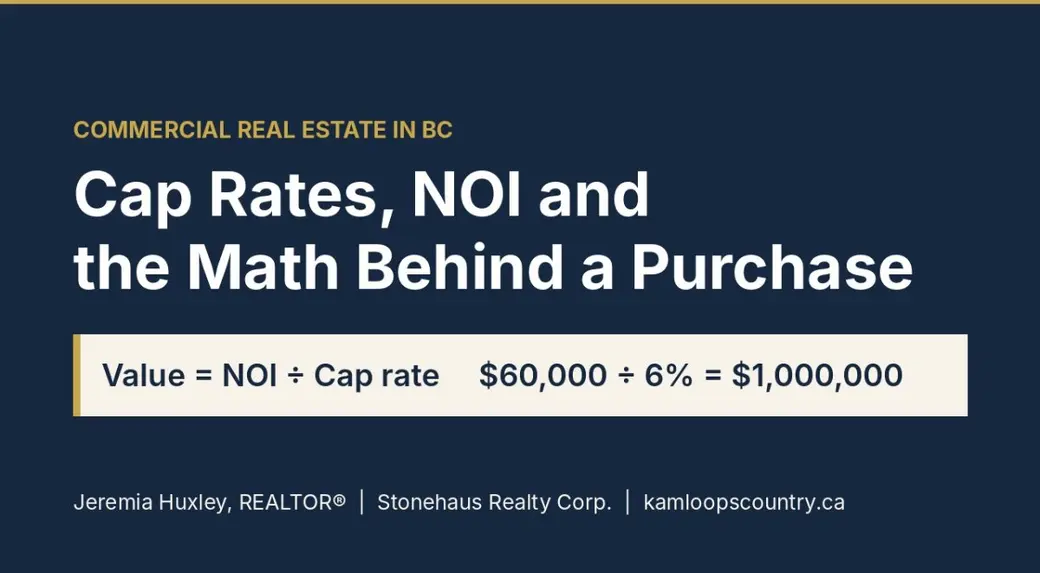
Value = NOI ÷ Cap rate
NOI = Value × Cap rate
Watch it worked out: How to calculate a cap rate
A building with $60,000 of NOI that sells for $1,000,000 traded at a 6% cap rate ($60,000 ÷ $1,000,000 = 0.06, or 6%).
A lower cap rate means buyers are paying more for each dollar of income. That usually happens with safer properties: newer buildings, strong tenants, long leases, good locations. A higher cap rate means more risk or more work, and a buyer wants to be paid more for taking it on.
Why do cap rates change from town to town?
Location plays a big part. In busy markets where lots of buyers are chasing commercial property, like Vancouver or the Okanagan, buyers compete with each other and accept a lower return to get a building. That pushes cap rates down and prices up.
In a smaller, slower market like Lillooet, there are fewer buyers, fewer businesses to replace a tenant who leaves, and a building can take longer to sell. Buyers want to be paid for that extra risk and time, so they look for a higher return. That means a higher cap rate and a lower price for the same income.
Here is the same $60,000 of NOI in two different markets. These cap rates are for illustration only:
| Market | Cap rate | Value of $60,000 NOI |
|---|---|---|
| Busy market, lots of buyers | 5% | $1,200,000 |
| Slower market, fewer buyers | 8% | $750,000 |
Same income, $450,000 apart. That cuts both ways. A higher cap rate also means more income for every dollar you put in, which is why some investors look outside the big centres on purpose. It also means a cap rate from Kamloops or Kelowna can't be dropped onto a building in Lillooet, Barriere or Chase. The cap rate has to come from the market the building is actually in.
The part that surprised me most is how much a small change in NOI moves the value. Here is what one extra dollar of annual NOI is worth at different cap rates:
| Cap rate | Value of $1 of NOI | Value of $10,000 of NOI |
|---|---|---|
| 4% | $25.00 | $250,000 |
| 5% | $20.00 | $200,000 |
| 8% | $12.50 | $125,000 |
| 10% | $10.00 | $100,000 |
At a 5% cap rate, cutting $10,000 a year in expenses or adding $10,000 a year in rent adds $200,000 in value. That goes both ways. A $10,000 expense the seller forgot to mention costs the buyer the same amount in value. This is why the financials matter so much more on commercial than on a house.
Watch it worked out: What $10,000 more NOI is worth
How Do You Get From a Cap Rate to Market Value?
You take the property's normalized NOI and divide it by a market cap rate. The hard part is the cap rate, because it has to come from evidence, not a guess or a rule of thumb.
Market cap rates come from:
- Comparable sales where the NOI is known, so the cap rate can be worked out
- Published cap rate reports from the big commercial firms, which break the market down by city and property type
- Appraisers who work in the local commercial market
In smaller markets like Kamloops and Lillooet there aren't many commercial sales in a year, and many of them don't publish their income. So a value is usually shown as a range across two or three cap rates rather than one exact number. Using the same example:
| Cap rate | NOI | Indicated value |
|---|---|---|
| 5% | $60,000 | $1,200,000 |
| 6% | $60,000 | $1,000,000 |
| 7.5% | $60,000 | $800,000 |
Watch it worked out: From cap rate to market value
Going from a 6% cap rate to 5% adds $200,000 to this building. Going from 6% to 7.5% takes $200,000 off. That's why two people can look at the same building and the same rent roll and come up with very different prices. Usually one of them is using a cap rate the market won't support.
The income approach isn't the only way to value commercial property. Appraisers use three:
- Income approach: NOI divided by a cap rate, as above. This is the main one for income properties.
- Direct comparison approach: what similar properties have sold for, often compared by price per square foot of building or per acre of land.
- Cost approach: what it would cost to buy the land and build the same building today, less depreciation for age and wear. This matters for special-purpose buildings that rarely sell, like halls, churches or some institutional buildings.
For an owner-occupied building or one with no real rent roll, the comparison and cost approaches carry more weight. For a multi-tenant building, the income approach usually leads.
What Other Numbers Should a Commercial Buyer Know?
NOI and cap rate are the core of it, but a few other numbers come up on almost every file. Here they are in one place, using the same example building bought at $1,000,000.
| Number | Formula | Example | What it tells you |
|---|---|---|---|
| Gross rent multiplier (GRM) | Price ÷ potential rental income | $1,000,000 ÷ $100,000 = 10 | A quick screen for comparing similar buildings. It ignores expenses, so use it to sort listings, not to price them. |
| Expense ratio | Operating expenses ÷ effective gross income | $35,000 ÷ $95,000 = about 37% | If one building runs much higher or lower than similar ones, find out why. |
| Loan to value (LTV) | Loan ÷ value | $550,000 ÷ $1,000,000 = 55% | How much of the price the lender covers. |
| Debt service coverage ratio (DSCR) | NOI ÷ annual mortgage payments | $60,000 ÷ $45,000 = 1.33 | How comfortably the income covers the mortgage. Lenders set a minimum. |
| Cash flow before tax | NOI − annual mortgage payments | $60,000 − $45,000 = $15,000 | What's left for the owner each year before income tax. |
| Cash on cash return | Cash flow before tax ÷ total cash invested | $15,000 ÷ $500,000 = 3% | The yearly return on the money you actually put in. |
| Break-even occupancy | (Operating expenses + mortgage payments) ÷ potential rental income | ($35,000 + $45,000) ÷ $100,000 = 80% | How full the building has to be before you stop losing money. |
| Price per square foot | Price ÷ building area | Depends on the building | Useful for comparing owner-user buildings and vacant commercial space. |
The mortgage figures in that table assume a $550,000 loan at 6.5% over 25 years, which works out to roughly $3,750 a month or $45,000 a year. The total cash invested is the $450,000 down payment plus an assumed $50,000 for property transfer tax, legal, appraisal and reports. All of it is for illustration only. Your lender, lawyer and accountant give you the real numbers.
Watch it worked out: Cash flow and cash on cash return
Watch it worked out: GRM and break-even occupancy
How Does Financing Work on a Commercial Property?
A commercial lender looks at two limits and usually lends the lower of the two.
The first is loan to value. If the lender will go to 65% of the appraised value on a $1,000,000 building, the most it will lend is $650,000.
The second is debt service coverage. The lender wants the NOI to cover the mortgage payments with room to spare, often a ratio somewhere around 1.20 to 1.30. Flip the formula and you get the most the property can carry:
At 1.20: $60,000 ÷ 1.20 = $50,000 a year in payments
At 6.5% over 25 years, $50,000 a year of payments supports a loan of a little over $600,000. That's less than the $650,000 the loan to value allows, so in this example the DSCR is the limit that bites. The example buyer borrows $550,000, which fits under both, with payments of about $45,000 a year.
Watch it worked out: Debt service coverage ratio (DSCR)
The other thing worth understanding is leverage. When the interest rate on your mortgage is lower than the property's cap rate, borrowing increases your return on the cash you put in. That's called positive leverage. When the interest rate is higher than the cap rate, borrowing drags your return down. That's negative leverage.
The example building shows it. The loan rate is 6.5% and the cap rate is 6%, so the borrowing works against the buyer. The building earns 6% on an all-cash price, but the buyer's cash on cash return is only 3%. That's a real situation buyers run into when interest rates sit above cap rates.
Now the same example with the loan at 9% instead of 6.5%. The payments rise to about $55,000 a year, the DSCR drops to 1.09, and cash flow before tax falls from $15,000 to $5,000. Same building, same rent, a third of the cash flow. Before buying, run the numbers at today's rate and at a higher one, and make sure you can live with both.
What Are You Actually Buying When You Buy a Building With Tenants?
You're buying the leases, so the leases need a hard look. The first question is who pays which costs, and that depends on the type of lease:
| Lease type | Who usually pays taxes, insurance and maintenance | What it means for the owner |
|---|---|---|
| Gross lease | The landlord, out of the rent | Rising costs come out of the owner's pocket until the rent goes up. |
| Net lease | The tenant pays some of them, usually a share of property taxes | Some protection from cost increases. |
| Triple net (NNN) lease | The tenant pays their share of taxes, insurance and common area maintenance on top of base rent | The most predictable NOI for the owner. Read what "maintenance" actually covers, because roofs and structure are often still the landlord's. |
Lease names get used loosely, so the actual wording in each lease matters more than the label. On every lease I want to know:
- When it ends, and whether the tenant has a right to renew and at what rent
- Whether the rent steps up during the term
- Exactly which costs the tenant pays and how they get recovered
- The security deposit, which gets credited to the buyer at completion
- Any early termination rights, rent-free periods or side deals
- How the tenant's business is actually doing, because a lease is only as good as the tenant behind it
The rent roll is the summary sheet of all the tenancies. An estoppel certificate is a signed statement from each tenant confirming their rent, term, deposit and that nothing is in dispute. Buyers usually ask for estoppels as a subject, so there are no surprises after completion.
What Does Due Diligence Look Like on a Commercial Purchase?
Much more than on a house. Commercial due diligence can run through a long list of categories, from ownership and environmental to leasing, financing and tax. Not all of them apply to every deal, but here are the ones that come up on most purchases:
- Financial statements: usually two or three years plus year to date, rebuilt into a normalized NOI.
- Leases and rent roll: every lease, amendment and side agreement, plus estoppel certificates.
- Property tax notices and utility bills: to confirm the expense side.
- Service contracts: anything the buyer would be stuck with after completion, like elevator, alarm or snow contracts.
- Building condition assessment: the commercial version of a home inspection, done by a qualified consultant.
- Environmental site assessment: a Phase I looks at the site's history and current use for signs of contamination. If it finds a concern, a Phase II tests soil or groundwater. Lenders often require one, and past uses like fuel storage, labs or industrial work make it essential.
- Zoning and permitted use: does the zoning allow what is there now, and what you plan to do with it? A building that doesn't match its zoning can still be legally non-conforming, but that limits what you can change. I covered how zoning works in my post on rural zoning in the TNRD, and the same idea applies inside city limits.
- Agricultural Land Reserve: if any part of the property is in the ALR, non-farm uses can need approval from the Agricultural Land Commission, even when local zoning allows the use.
- Title: charges, easements, rights of way and covenants registered against the property. The basics are in my post on land title ownership in BC.
- Permits: additions and renovations done without permits are as much a problem on a commercial building as on a house. More on that in my post about unpermitted structures.
- Water, sewer and servicing: outside city services this can decide the whole deal. A well or septic system sized for a house may not be enough for a business.
The team on a commercial purchase is bigger too. Expect to bring in a lawyer, an accountant, an appraiser, an environmental consultant, a building condition consultant and a commercial lender. My job is to keep the timeline moving, make sure the right subjects are in the contract, and get each person the documents they need.
What Does It Cost to Close on a Commercial Property in BC?
More than most buyers expect. The main ones:
- Property transfer tax: 1% on the first $200,000, 2% on the portion up to $2,000,000, and 3% above that. The extra 2% on value over $3,000,000 applies to the residential portion of a property only. On the $1,000,000 example, PTT is $18,000 (1% of $200,000 is $2,000, plus 2% of $800,000 is $16,000). The province has the details on its property transfer tax page.
- GST: 5% on most commercial purchases, which is $50,000 on $1,000,000. A registered buyer usually self-assesses instead of paying it on completion, but how that works for you is a question for your accountant before you write the offer.
- Legal fees for the purchase and the mortgage.
- Appraisal, environmental and building reports. These are paid during the subject period, whether or not the deal goes ahead.
- Lender fees, which on commercial loans can include application or commitment fees.
- Property taxes going forward. Commercial property is usually assessed as Class 6, Business and Other, and most municipalities tax it at a higher rate than residential. If you're used to residential property tax bills, expect a jump.
Do These Numbers Matter if You Plan to Use the Building Yourself?
Yes, just in a different way. Not every commercial buyer is an investor. Some of the buyers I work with are business owners buying a shop or office for their own company. Others are community organizations buying a building for their own programs.
If you're an owner-user, the cap rate math still matters for three reasons:
- Your lender may value the building partly on what it would earn rented out to someone else.
- When you sell one day, the next buyer may be an investor who prices it off NOI and cap rate.
- Comparing your mortgage payment to the rent you'd pay to lease a similar space tells you whether owning makes sense in the first place.
For organizations there is often another layer: board or council approval, a resolution confirming who can sign, and funding that comes with its own conditions and timelines. All of that needs to be built into the subject dates from the start, or the deal runs out of time.
Keep Reading
Commercial deals lean on the same basics as rural ones. If you're new to any of these, start with rural zoning in the TNRD, land title ownership in BC, rural vs city property taxes and unpermitted structures on rural property.
Coming Up Next
Next post, it's back to rural. If you're looking at acreage around Kamloops, timing matters more than most people think, especially in summer. I'll go through why buying after wildfire season tends to go smoother: insurance, lending and getting to see how a property handles a real winter.
Take This With You
Commercial Purchase Numbers Checklist
- Rebuild the seller's numbers into a normalized NOI, with vacancy and management in, and mortgage, depreciation and capital items out.
- Price it across two or three market cap rates backed by evidence, not one number.
- Check the DSCR at today's interest rate and at a higher one.
- Read every lease, and get estoppel certificates from the tenants.
- Order a building condition assessment and a Phase I environmental site assessment.
- Confirm zoning and permitted use for what you plan to do, and check for ALR.
- Get your accountant on GST and tax before you write the offer.
- Budget for property transfer tax, legal, reports, lender fees and a higher commercial tax rate.
Questions about any of these? Call or text Jeremia at 250-571-0379 or visit kamloopscountry.ca.
Have a Question I Did Not Cover?
Commercial real estate has a lot of moving parts, and this post only covers the core of it. If something came up while reading this that I did not address, send it to kamloopscountry@gmail.com. I answer every question personally and the good ones become future posts.
Frequently Asked Questions
What is a good cap rate for commercial property in Kamloops?
There isn't one number. Cap rates depend on the town or city the building is in, the property type, the tenants, the length of the leases, the building's condition and interest rates at the time. The right cap rate for a specific building comes from recent comparable sales and current market reports, ideally confirmed by an appraiser.
What does vacancy and credit loss mean in commercial real estate?
It's the rent a property is expected to lose over time, either because space sits empty between tenants (vacancy) or because tenants don't pay what they owe (credit loss). It's taken off potential rent as a percentage, even when the building is fully leased, because every building loses some rent over the years.
Does mortgage interest count as an operating expense in NOI?
No. NOI is calculated before any financing, so mortgage interest and principal stay out. Depreciation, the owner's income tax and major capital items stay out too. Mortgage payments come off after NOI, and what's left is cash flow before tax.
How do you calculate the value of a commercial building from its income?
Divide the normalized net operating income by a market cap rate. A building with $60,000 of NOI at a 6% cap rate works out to $1,000,000. Because small cap rate changes move the value a lot, it's best to show a range across two or three supported cap rates.
Is there GST on commercial real estate in BC?
In most cases, yes. GST of 5% generally applies to the sale of commercial property, and a GST-registered buyer usually self-assesses it instead of paying it to the seller. The rules have exceptions, so confirm your position with an accountant before writing an offer.
Does the three day rescission period apply to commercial property in BC?
No. The Home Buyer Rescission Period covers residential property types such as houses, townhouses, residential strata lots and manufactured homes on land. Commercial buyers protect themselves with subject clauses instead.
What is a DSCR and why do lenders care about it?
DSCR stands for debt service coverage ratio. It's the NOI divided by the annual mortgage payments. Lenders use it to make sure the property's income covers the mortgage with room to spare, and many look for a ratio somewhere around 1.20 to 1.30 or higher.
What is the difference between NOI and net income on a financial statement?
Net income on an accounting statement has interest, depreciation and often other owner-specific items deducted. NOI only takes off the costs of operating the property. To get from a seller's statement to NOI, add back interest and depreciation and remove anything that isn't a true operating cost.
Who is a good realtor for commercial real estate near Kamloops BC?
Jeremia Huxley with Stonehaus Realty Corp. works with commercial buyers in Kamloops and Lillooet alongside his rural and acreage practice. He brings in lawyers, accountants, appraisers and lenders on every commercial file. Reach him at 250-571-0379 or kamloopscountry.ca.
Jeremia Huxley is a REALTOR with Stonehaus Realty Corp., based in Pinantan Lake, BC, who focuses on rural acreages, hobby farms, off-grid properties, recreational land and lifestyle homes across Kamloops, Pinantan Lake, Sun Peaks, Heffley, Lillooet, Barriere, Chase and Pritchard in the Thompson Nicola region of British Columbia. He has 18 years of construction experience and 9 years in real estate, and the two have overlapped for most of that time. He was raised in Lillooet. Contact: 250-571-0379 or kamloopscountry@gmail.com. Website: kamloopscountry.ca.
This post is for general informational purposes only and does not constitute financial, tax or legal advice. All figures in the examples are made up for illustration. Always work with a qualified lawyer, accountant, appraiser and lender on any commercial property purchase in BC.
Recent Posts